
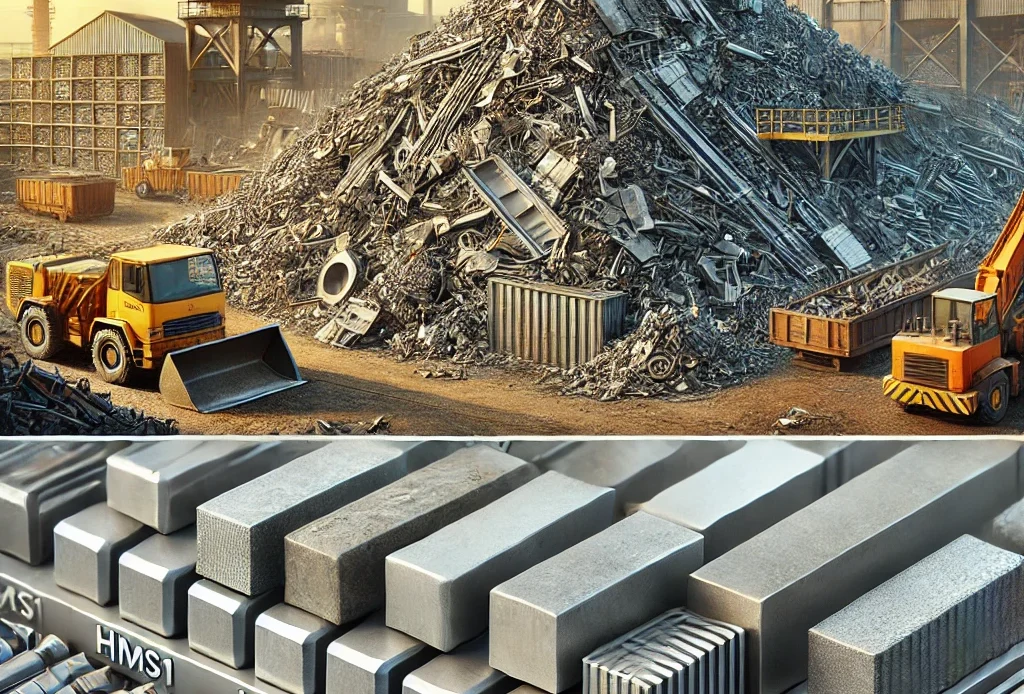
Steel Scrap (HMS1 & HMS2) and Billets – Summary
Steel scrap, especially HMS1 and HMS2, as well as billets, are essential raw materials in the steel manufacturing industry. These materials are used to produce various steel products, which are foundational to sectors like construction, automotive, machinery, and infrastructure.

Here’s a detailed summary of each:
1. Steel Scrap (HMS1 & HMS2)
Overview: Steel scrap is recycled metal that is collected and processed to make new steel products. It’s a major raw material in electric arc furnaces (EAF) for steel production and helps reduce the consumption of raw iron ore and coal. Steel scrap is classified into different categories based on its quality, size, and composition.
Types of Steel Scrap:
- HMS1 (Heavy Melting Scrap 1):
- Description: HMS1 is the highest quality of scrap, consisting of heavier, larger steel pieces. It mainly includes uncoated, clean, and rust-free steel scrap from demolition projects, such as large steel beams, structural steel, and machinery.
- Criteria: The scrap should be free from non-metallic contaminants like wood, plastic, or glass. HMS1 scrap is typically larger in size (usually above 6 mm in thickness).
- Applications: It is primarily used in electric arc furnaces (EAF) to produce high-quality steel products.
- HMS2 (Heavy Melting Scrap 2):
- Description: HMS2 is a lower-grade scrap compared to HMS1. It includes smaller and thinner steel pieces such as steel plates, pipes, and other items that are typically lighter and smaller in size.
- Criteria: While still a valuable source of recycled metal, HMS2 may contain some impurities such as rust, paint, or other minor contaminants.
- Applications: HMS2 is also used in EAF production, but typically results in a slightly lower-quality steel compared to HMS1.
- HMS1 (Heavy Melting Scrap 1):
Process:
- Collection: Scrap steel is gathered from construction sites, old vehicles, machinery, and industrial waste.
- Sorting & Cleaning: The steel is cleaned and sorted based on quality to ensure that only usable scrap is processed.
- Melting: The scrap is melted in electric arc furnaces to produce steel, which can then be cast into billets, ingots, or rolled into steel products.
Global Trade:
- Steel scrap is traded globally, with major exporters including the United States, Japan, and European Union. Importing countries typically include India, Turkey, South Korea, and other developing economies with a growing steel industry.
2. Billets
Overview: A billet is a semi-finished product in the form of a rectangular or square metal bar, which is produced through casting and is used as a starting material for manufacturing finished steel products. Billets are produced by melting scrap steel or iron ore and then casting them into these shapes for further processing.
Types of Billets:
- Carbon Steel Billets: Made primarily from steel scrap or direct reduced iron (DRI). These billets are used for a variety of products such as bars, rods, and pipes.
- Alloy Steel Billets: Made by adding alloying elements to the base steel, such as chromium, nickel, and vanadium, to improve specific properties like strength, hardness, and corrosion resistance. These billets are used in high-performance applications like automotive, aerospace, and machinery.
Production:
- Casting: Billets are typically cast from molten steel in continuous casting machines, where the steel is poured into molds to form rectangular or square bars.
- Rolling: Once cast, billets are heated and rolled into products like bars, rods, or wire.
- Applications: Billets are used as the base material in the production of long steel products such as bars, rebar (reinforcing steel), structural shapes, and pipes.
Global Trade:
- Billets are traded globally as they serve as an essential feedstock for many steel mills. Countries like China, Russia, and India are major producers and exporters of billets, while countries in Europe, Turkey, and the Middle East are significant importers.
Summary of Steel Scrap (HMS1 & HMS2) and Billets:
- HMS1 (Heavy Melting Scrap 1): Higher-quality steel scrap consisting of heavy, large steel items, used in electric arc furnaces for high-quality steel production.
- HMS2 (Heavy Melting Scrap 2): Lower-grade steel scrap consisting of smaller, lighter items, also used in EAF for steel production but results in lower-quality steel compared to HMS1.
- Billets: Semi-finished steel products that are cast into rectangular or square shapes and serve as raw material for producing various steel products like bars, rods, and pipes.
Key Considerations:
- Recycling: Steel scrap is an important resource for the steel industry, contributing to sustainability by reducing the need for raw iron ore and conserving energy.
- Quality Control: The quality of steel produced from scrap depends largely on the quality of the scrap (HMS1 vs. HMS2) and the purity of the material used in the furnace.
- Global Demand: The demand for steel billets is influenced by construction, infrastructure development, and manufacturing sectors worldwide.
These materials—steel scrap (HMS1 and HMS2) and billets—are central to the global steel industry, driving both sustainable recycling practices and the continued development of infrastructure, construction, and manufacturing sectors globally.